No. And as of June 12, 2026, it is not even available. Just three days after its high-profile release, Anthropic officially suspended access to Claude Fable 5 and Claude Mythos 5 due to compliance and safety concerns.
This sudden, dramatic shutdown is the ultimate proof of why a "powerful" model might not be the best model for your actual work. For real-world business operations, safety, stability, and reliable availability are far more valuable than volatile, cutting-edge reasoning power that can vanish overnight.
While Anthropic's now-suspended engineering marvel was built for autonomous software engineering and genomic research, its astronomical $10 per million input and $50 per million output token rates made it highly cost-inefficient for routine business office tasks anyway.
Here is why Claude Fable 5 was not the right choice for your daily workflow, and how a practical, workspace-integrated AI can solve your real problems at a fraction of the cost. For a side-by-side look at consumer assistants, frontier models, and desktop agents, see Siri App Intents vs AI Desktop Agent for Productivity in 2026.
Claude Fable 5 was too expensive for routine office tasks because its pricing was double the cost of older, equally capable models without offering any performance increase for standard document work. According to Anthropic, the longer and more complex the task, the larger Fable 5's lead over other models. In other words, for standard knowledge tasks, Fable 5 performed roughly the same as much cheaper models.
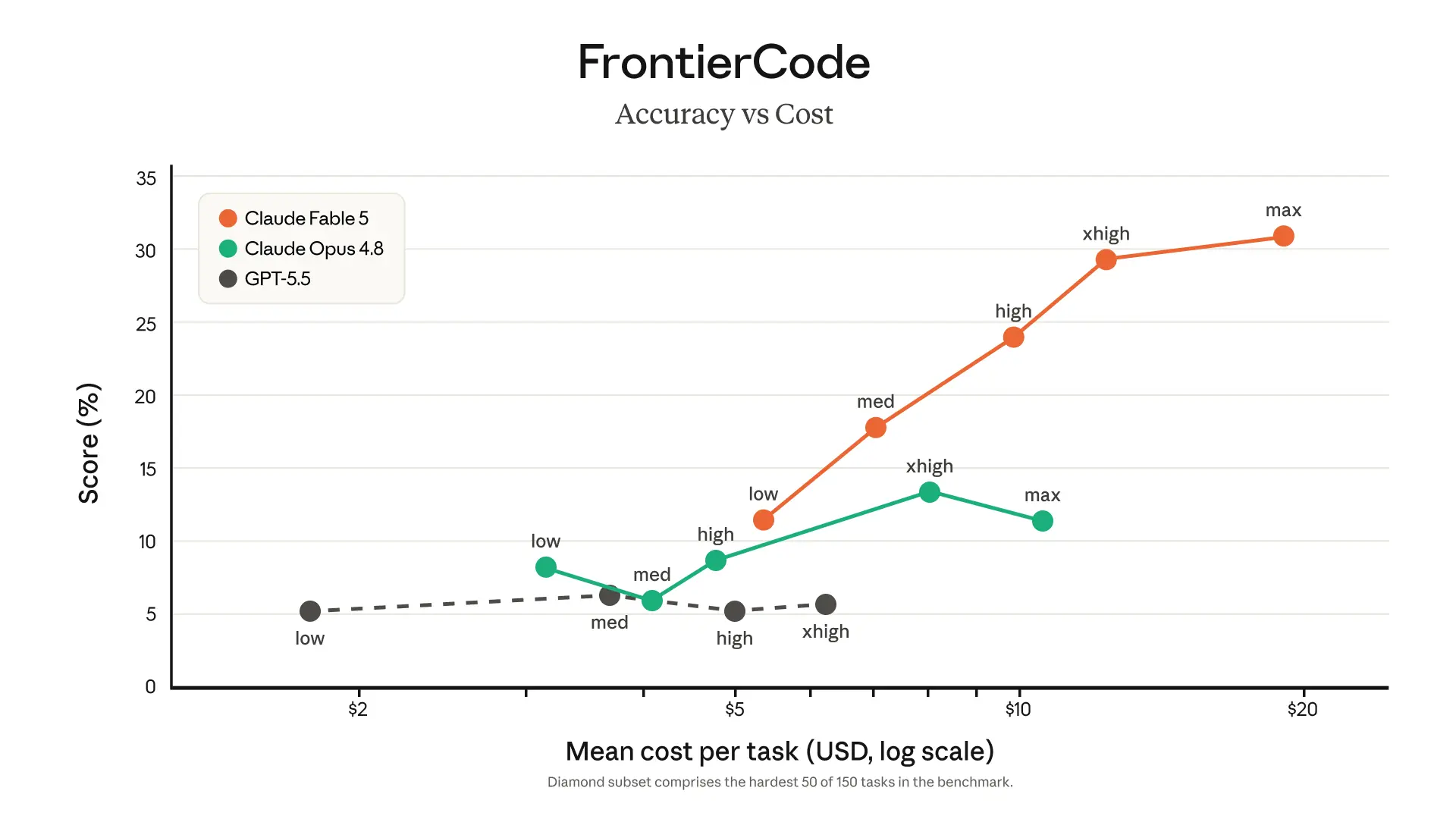
This graph provides empirical proof that Fable 5 was exclusively for "Ambitious" Tasks. For a majority of knowledge workers, running a model that scaled into $20 per task was financially ruinous.
For routine tasks like drafting emails, reviewing standard Word documents, or compiling meeting summaries, you would have seen less noticeable difference in quality between Fable 5 and models that cost half as much. Using Fable 5 for these tasks was essentially driving a commercial semi-truck to the grocery store. It was expensive to run, hard to manage, and completely unnecessary for the trip.
| Model | Input Cost (per 1M tokens) | Output Cost (per 1M tokens) |
|---|
| Gemini 3.5 Flash | $1.50 | $4.50 |
| Gemini 3.1 Pro | $3.00 | $9.00 |
| Claude Sonnet 4.6 | $3.00 | $15.00 |
| GPT-5.5 | $5.00 | $15.00 |
| Claude Opus 4.8 | $5.00 | $25.00 |
| Claude Fable 5 | $10.00 | $50.00 |
According to a 2026 Workday study, a staggering 82% of office workers say they waste significant time acting as "translators"—manually copying and pasting data between disconnected software tools. It's no wonder 43% of knowledge workers report feeling busy but entirely unproductive at the end of the day.
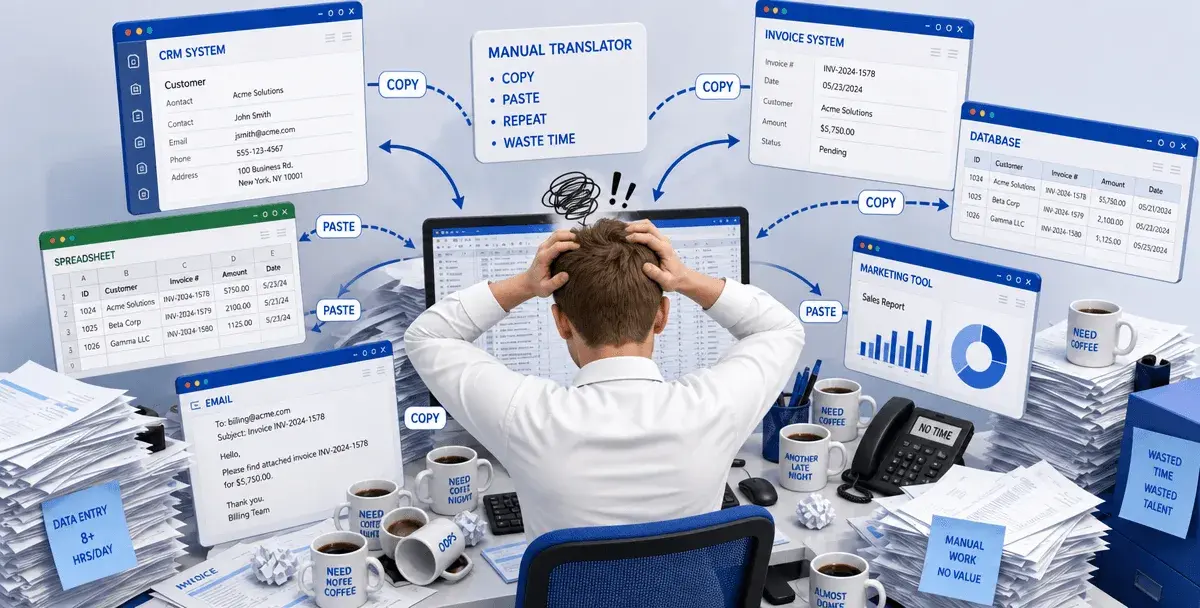
Knowledge workers do not suffer from a lack of "ambitious" reasoning power. Their biggest bottleneck is grunt work: the friction of shifting data between spreadsheets, email clients, CRMs, and folders.
Claude Fable 5 did solve the problem, but in an extremely luxurious way.
Claude Fable 5 frequently halts routine business workflows because its overactive cybersecurity and biosecurity classifiers trigger false positives on benign data and scripts.
An analysis of early user discussions on Reddit shows that Fable 5's safeguard classifiers are highly sensitive and prone to false positives. Because Fable 5 is equipped to handle advanced risks (like cybersecurity threats and biochemical engineering), its filters are tuned to block anything that even remotely resembles a hazard.
For instance, developers and researchers have reported that Fable 5 routinely refuses to run simple Python scripts, blocks database queries, or refuses to analyze agricultural data due to "biosecurity" false positives.
If you are an accountant writing macros or a loan officer processing sensitive financial histories in QuickBooks or Excel, these false positives can bring your productivity to an abrupt halt. Worse yet, when Fable 5 flags a query, it often triggers a mid-session downgrade to Claude Opus 4.8, double-billing you for premium Fable 5 credits while delivering lower-tier model responses.
This hyper-sensitivity and instability culminated in a complete service shutdown. On June 12, 2026, Anthropic published an official update suspending all access to Claude Fable 5 and Claude Mythos 5. According to industry reports, the models were pulled after regulatory concerns and claims of severe safety bypasses (jailbreaks) that slipped past their safety classifiers.
This situation highlights a fundamental truth for modern businesses: the "best" model is not the one with the highest theoretical benchmarks. The best model is the one that is safe, stable, and consistently available. Relying on a highly volatile, bleeding-edge model means risking your entire operations going offline at a moment's notice when a provider pulls the plug.
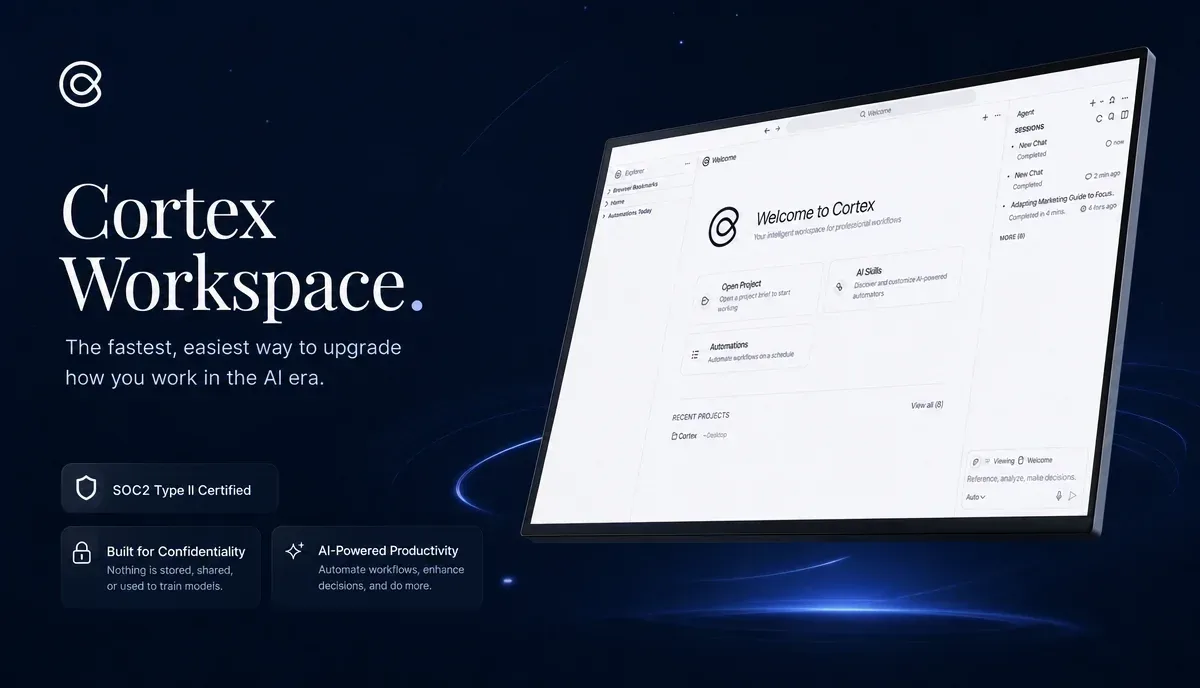
While major AI labs struggle with compliance suspensions and sudden model recalls, Cortex Workspace remains fully operational, stable, and ready to use. Because Cortex Workspace is model-agnostic, it does not lock you into a single volatile model. Instead, it allows you to utilize stable, highly reliable, and safe models (like Gemini 3.5 Flash or Claude Sonnet 4.6) to automate your day-to-day office operations without interruption.
Cortex Workspace offers a highly cost-effective alternative by running directly inside your local desktop environment to automate cross-application data entry without manual copy-pasting. Unlike isolated web-based chat boxes, Cortex Workspace operates as an AI Desktop Operator. It acts as a bridge between your local documents, spreadsheets, and web portals to automate manual admin work.
For example, instead of manually reviewing a PDF bank statement and copying figures cell-by-cell into a mortgage underwriting Excel sheet—a process that wastes 15 to 20 minutes per file—you simply direct Cortex with a plain-text prompt:
Extract the borrower's name, monthly income, and total liabilities from the attached bank statement PDF, and fill them into their corresponding cells in the active Mortgage Underwriting Spreadsheet.
Cortex then reads the PDF and executes the spreadsheet edits automatically. This cuts entry times from 15 minutes to 45 seconds per file, saving knowledge workers 2 to 3 hours of manual labor every day. It works directly inside your existing tools (such as Microsoft Excel, Word, and Salesforce) without requiring massive, expensive prompt configurations.
Upgrading to a more integrated desktop operator is the most practical way to eliminate daily clerical grunt work without paying premium AI token pricing. Before chasing the next suspended frontier model, evaluate where your daily friction actually lies.
If your team is wasting hours moving data from window to window, you don't need a multi-million dollar scientific reasoning model; you need an integrated desktop workspace assistant.
Cortex Workspace does not replace human judgment or professional evaluation. It removes the repetitive browser work that happens before judgment can start. From there, you can tackle your "most ambitious work", better than any AI model can.
Try Cortex for free today and see how much time you save when your AI actually works with your files.