The latest AI can read your entire loan file and return a complete analysis in one shot — income, DTI, liabilities, MISMO updates, and red flags — in under 5 minutes vs 90–120 minutes manually. We tested four models (Gemini 3.5 Flash, Gemini 3.1 Pro, GPT-5.4 Mini, Claude Sonnet 4.6) on the same FHA loan file with the same prompt.
- All four models were tested on an identical loan file using the same prompt (income calculation, DTI, liability extraction, MISMO updates, and red flag detection)
- GPT-5.4 Mini made a calculation error that carried through its entire analysis
- Claude Sonnet 4.6 produced the deepest analysis
- Gemini 3.5 Flash was the only model that produced ready-to-use deliverables without being asked
- Gemini 3.1 Pro caught a unique fraud indicator that no other model detected
- No single model caught everything. The strongest workflows use models selectively based on the task at hand.
The pain isn't that the work is hard. It's exhausting in a way that doesn't scale.
You open the folder with all the needed files (credit report, pay stubs, W2s, bank statements, MISMO, etc.) and send one prompt:
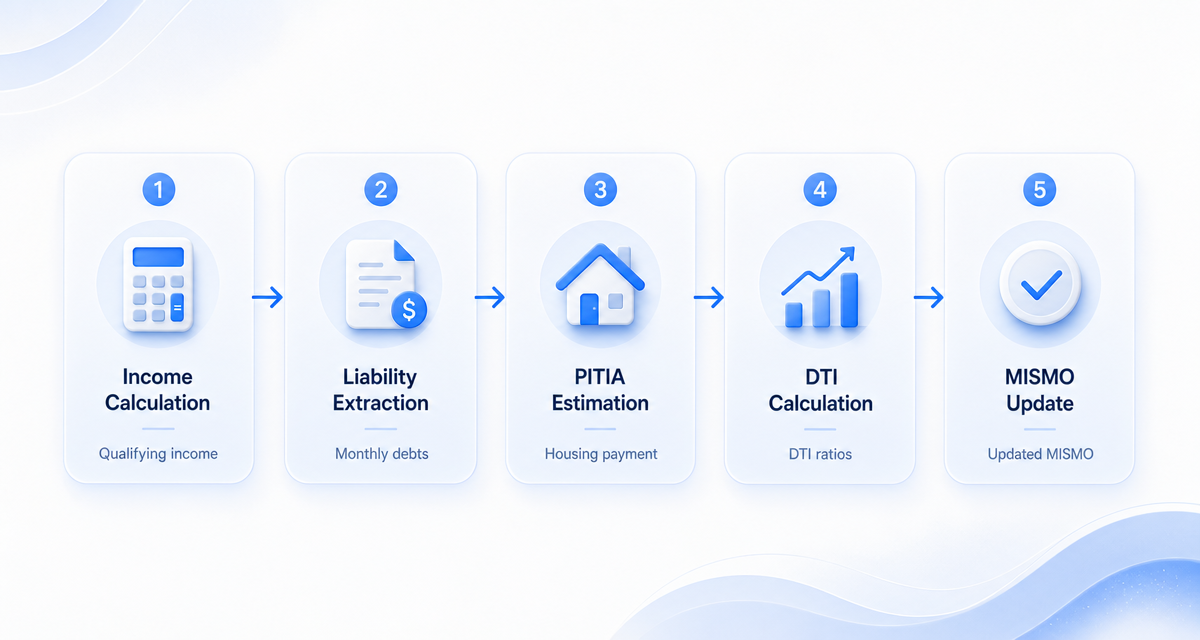
"Review everything and: calculate qualifying income, pull liabilities from the credit report, estimate PITIA, calculate DTI and flag if it exceeds FHA limits, tell me what needs to be updated in the MISMO file, and flag any other concerns."
Within 5 minutes, you get a structured analysis covering all six steps. The AI reads every document, does the math, cross-references the files, and surfaces issues you might have missed.
The same loan files were run through four models (Gemini 3.5 Flash, Claude Sonnet 4.6, GPT-5.4 Mini, and Gemini 3.1 Pro) using the identical prompt. Here's how they stacked up across the dimensions that actually matter.
This is the baseline. Get the income wrong and everything downstream is wrong.
When it comes to bi-weekly income calculation, GPT-5.4 Mini got this wrong. Its response read:
"Gross monthly income: $3,000 bi-weekly x 2 = $6,000/month"
It treated bi-weekly as twice-monthly, which is a common mistake. The correct approach is to account for the fact that bi-weekly employees receive 26 paychecks a year, not 24. That error carried through into its DTI figures and its MISMO update recommendation. The output looked confident but still wrong.
Conclusion: Gemini 3.5 Flash = Claude Sonnet 4.6 = Gemini 3.1 Pro > GPT-5.4 Mini
Beyond getting the numbers right, how far did each model go?
Claude Sonnet 4.6 went furthest. On DTI, rather than just flagging that it was high, it modeled what would actually fix it:
"Paying off the auto loan would reduce monthly liabilities to $390 and lower the back-end DTI from 56.45% to 48.98%, significantly increasing the likelihood of AUS approval."
Gemini 3.5 Flash was accurate and thorough but stopped at flagging issues rather than solving them. Gemini 3.1 Pro's MISMO update section was notably vague:
"The current MISMO liability set appears outdated"
Conclusion: Claude Sonnet 4.6 > Gemini 3.5 Flash > Gemini 3.1 Pro
This is where the files get interesting. Each model caught different things.
Gemini 3.1 Pro found something none of the others did: the bank statement totals didn't mathematically reconcile with the itemized transactions, which is a potential document fraud indicator.
Claude Sonnet 4.6 caught the most issues overall: the undisclosed mortgage, the three-way address mismatch, the asset shortfall, the Zelle transfer requiring a gift letter, and the tax refund that shouldn't be counted as income.
Gemini 3.5 Flash caught most of the same issues minus the hidden mortgage.
GPT-5.4 Mini missed both of these entirely, along with the asset shortfall and the identity mismatches.
Conclusion: Claude Sonnet 4.6 for breadth; Gemini 3.1 Pro for a unique fraud catch
This is the dimension that separates useful from impressive.
Gemini 3.5 Flash was the only model that didn't just analyze the file but also produced deliverables — a corrected, submission-ready MISMO XML and a formatted summary report with a clear executive summary, ready to hand to a processor or drop into your workflow. It did this without being asked.
Every other model ended with a list of recommended changes. Gemini 3.5 Flash ended with the changes already made.
For a loan officer, that's the difference between saving 30 minutes and saving 2 hours.
Conclusion: Gemini 3.5 Flash > Claude Sonnet 4.6 = Gemini 3.1 Pro = GPT-5.4 Mini
The clearest takeaway from this test: no single model caught everything, and each had a distinct strength. The best AI workflow for loan officers is not one model — it is the right model for the right task.
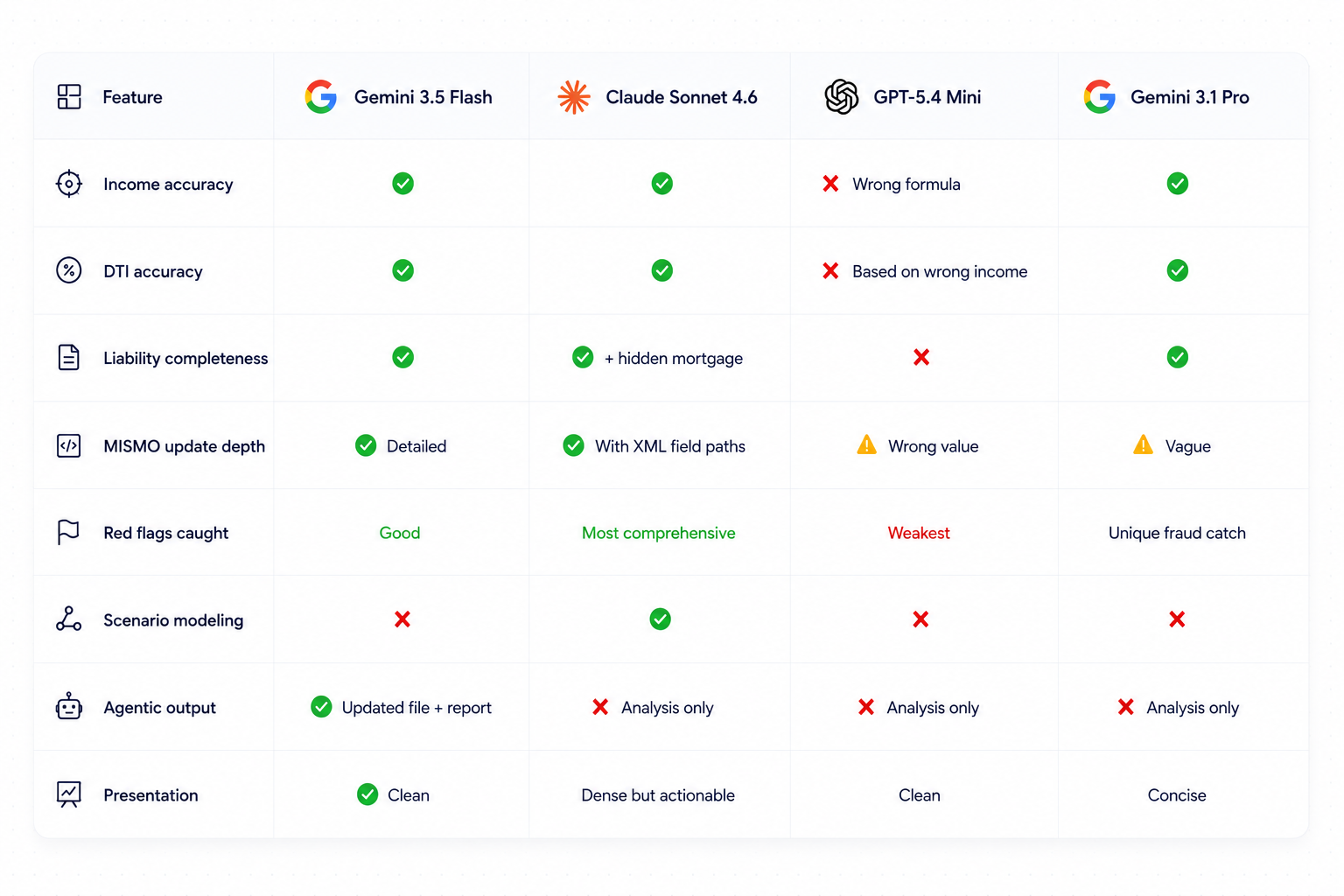
| Dimension | Gemini 3.5 Flash | Claude Sonnet 4.6 | Gemini 3.1 Pro | GPT-5.4 Mini |
|---|
| Bi-Weekly Income Calculation | ✅ Correct (26 paychecks/yr) | ✅ Correct | ✅ Correct | ❌ Incorrect (24 paychecks/yr) |
| DTI Calculation Accuracy | ✅ Accurate | ✅ Accurate with fix modelling | ✅ Accurate | ❌ Carried forward error |
| Depth of Analysis | Good — flags issues | Best — models solutions | Vague on MISMO | Surface-level |
| Red Flag Detection | Most issues caught | Most comprehensive (5 flags) | Unique fraud catch | Missed key flags |
| Document Fraud Detection | Not detected | Partial | ✅ Bank statement reconciliation mismatch | ❌ Missed |
| Agentic Output (deliverables) | ✅ MISMO XML + summary report | Analysis only | Analysis only | Analysis only |
| Best Use Case | End-to-end file processing | Complex risk assessment | Fraud-suspicious files | Simple Q&A only |
Cortex is a desktop AI agent built for knowledge workers in document-heavy industries. It installs like a standard desktop app and connects directly to the files and web apps you already use — Microsoft 365, Google Suite, LOS platforms — without routing data through third-party servers.
The 4 tested models above are all available through Cortex Workspace under a single subscription. No separate API accounts. No switching between browser tabs. You select the right model for the task from one interface.
All files and tools in one place. The typical AI setup today means juggling your LOS in one tab, the AI chatbot in another, and documents in a third — switching context an average of 30–50 times per file review. Cortex Workspace eliminates that: your loan documents, your LOS, and your AI models operate in a single environment.
Borrower data never leaves your machine. Uploading a borrower's bank statement or pay stub to a standalone AI chatbot sends that data to a third-party server. With Cortex, files are opened and processed locally — the AI reads your documents without transmitting sensitive borrower information externally.
From analysis to deliverable in one session. As demonstrated in this test, Gemini 3.5 Flash produced a corrected, submission-ready MISMO XML and a formatted processor summary — without additional prompting — saving an estimated 90–120 minutes per file compared to manual completion. Cortex Workspace makes this the default experience across all four models.
Cortex Workspace does not replace loan officer judgment. It removes the repetitive file-switching and manual data work that happens before judgment can start.